
Modules and hardware
CPU/GPU contact, mounting, board/chassis fit and residual airflow.
An integrated liquid-cooled workstation brings CPU and GPU cooling, chassis space, noise, controls and service access into one design. This guide explains how to choose the cooling arrangement and define the hardware and tests included in the project.
View Integrated Systems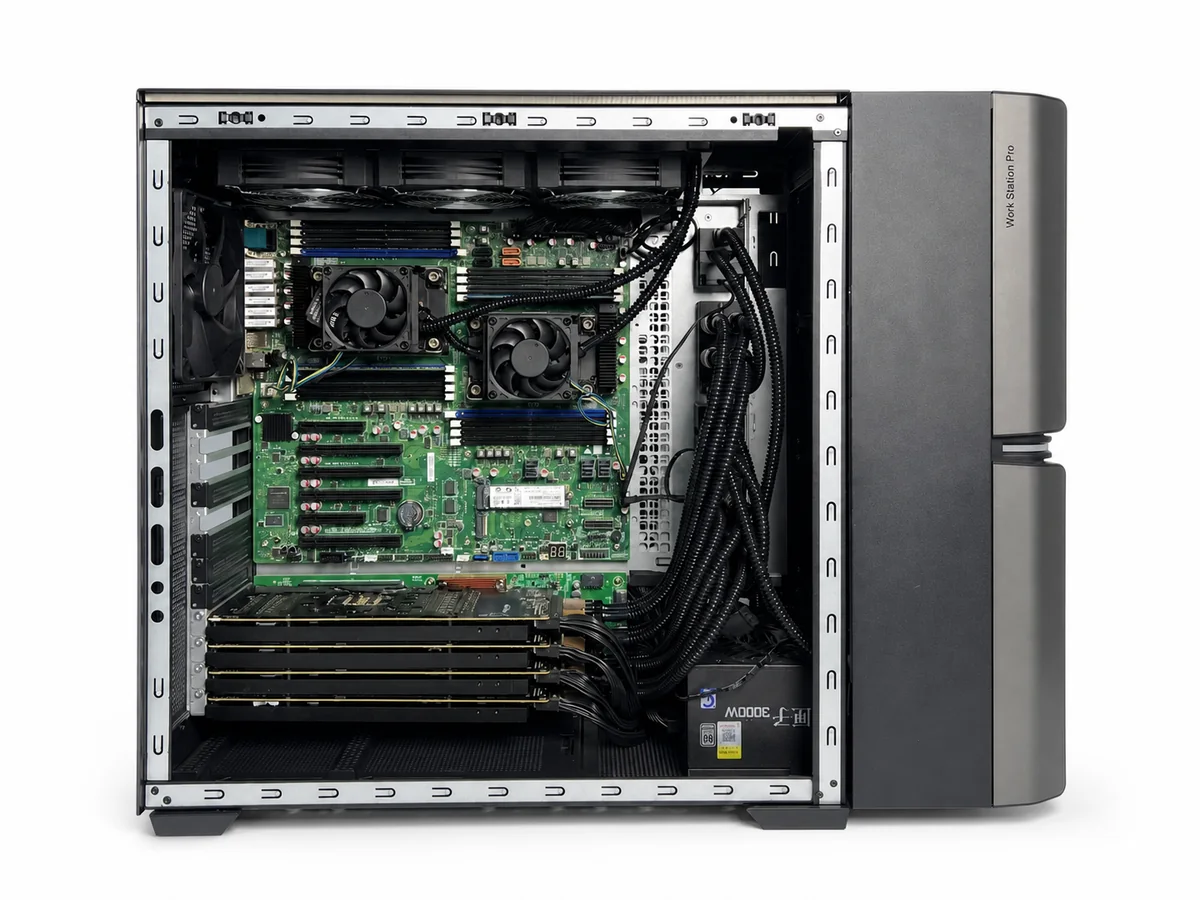
Choose the least complex architecture that can meet the defined workload, temperature, acoustics, space, service and lifecycle requirements.
| Path | Best starting point when | Main trade-off to review |
|---|---|---|
| Air cooled | Available airflow can meet the thermal and acoustic target | Fan power, noise, density and hotspot margin |
| Liquid cooling module | Your team owns the chassis, control and complete system | Interface and customer-integration responsibility |
| Integrated liquid system | The complete loop and configuration must be coordinated together | More interfaces, control, maintenance and validation scope |
List the CPU, GPUs, chassis, cooling parts, controls and software. Identify which items the supplier provides and which you provide before comparing system proposals.
CPU/GPU contact, mounting, board/chassis fit and residual airflow.
Tubing, pump, coolant, sensors, fan/pump control and abnormal-state input.
Radiator, fans, enclosure path, ambient and service/cleaning access.
| Owner | Must be written into scope |
|---|---|
| Customer | Intended use, hardware, software/firmware and system safety responsibility |
| ThermalBro | Agreed cooling hardware, configuration, manufacturing and evidence |
| Shared | Interfaces, acceptance, integration changes and release |
The system must respond to real application modes, not only a component rating. Define how pumps and fans behave during startup, sustained load, rapid load change and faults.
| Control state | Define |
|---|---|
| Startup | Prime, sensing and safe initial fan/pump behavior |
| Steady load | Temperature/noise target and control authority |
| Load change | Response rate and stability expectation |
| Fault | Detection input, degraded mode and system owner |
An integrated loop introduces additional connections and service actions. Risk controls should address prevention, detection, response and the person responsible for each action.
| Risk | Prevention | Detection / evidence | Owner |
|---|---|---|---|
| Leakage | Controlled sealing, connections and assembly | Defined leak check and system inspection | Per supplied boundary |
| Condensation | Coolant/ambient/dew-point design | Environmental and operating review | System control owner |
| Service error | Access, labeling, fill/drain and instructions | Maintenance trial and record | Product/service team |
| Configuration change | Controlled hardware and BOM | Impact review and revalidation | Change authority |
Define the workstation configuration, workload, temperature and noise targets. The quotation should identify the included hardware, software, testing and documents.
A module is supplied into a system architecture retained by the customer. An integrated system coordinates an agreed complete liquid loop and configuration, including module, tubing, pump, heat rejection, fans, controls and configuration-level acceptance responsibilities.
No. Noise depends on workload, heat-rejection area, pump and fan selection, control strategy, vibration, chassis structure, ambient and measurement method. The complete configuration must be measured under a defined condition.
Control and monitoring ownership must be written into the project scope. ThermalBro can coordinate agreed hardware or interface requirements, while customer firmware, operating software and system safety functions remain with the identified owners.
Validation combines module checks with real hardware, application workload, ambient, acoustics, controls, abnormal states, maintenance and transport as required. The acceptance plan names the condition, method, criterion, record and owner.
Product examples: ThermalBro integrated workstation systems. Complete-system performance depends on the configuration and test conditions.
Send the hardware list, workload, environment, noise target and required delivery scope. We will help assess a module or integrated-system approach.