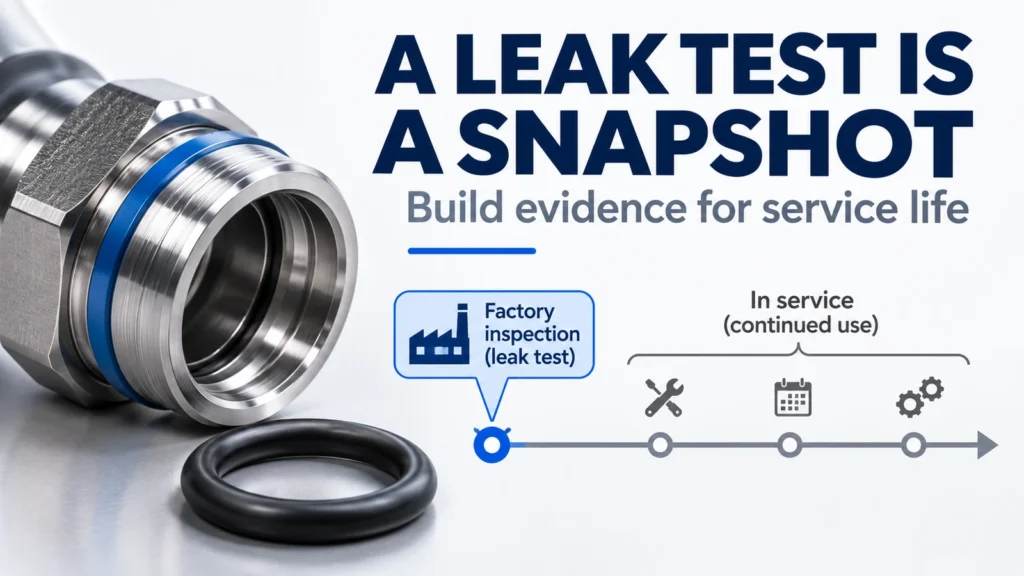
No. Passing a liquid cooling leak test means the tested assembly met a defined tightness criterion under the recorded test conditions. It does not establish that the assembly will remain leak-free through every temperature cycle, coolant exposure, handling event or service intervention over its life.
A useful purchasing requirement connects three kinds of evidence: production screening, qualification for the intended duty, and controls during installation and service. Each answers a different question. Combining them supports a bounded reliability decision; calling one factory pass a lifetime guarantee does not.
Read the pass as a result for a particular assembly state
A leak-test report should identify what was tested and how the decision was made. A cold plate tested before hoses were attached does not cover the later joints. Temporary plugs may exclude the final mating connector. Reopening an interface after testing changes the state to which the original result applies.
- Identity. Unit or batch, drawing/BOM revision, assembly state and test date.
- Boundary. Included joints, temporary closures, fixtures and connections left to the system integrator.
- Method. Medium, pressure reference, temperature, stabilization and measurement interval.
- Decision. Units, acceptance threshold, measured result, exceptions and disposition.
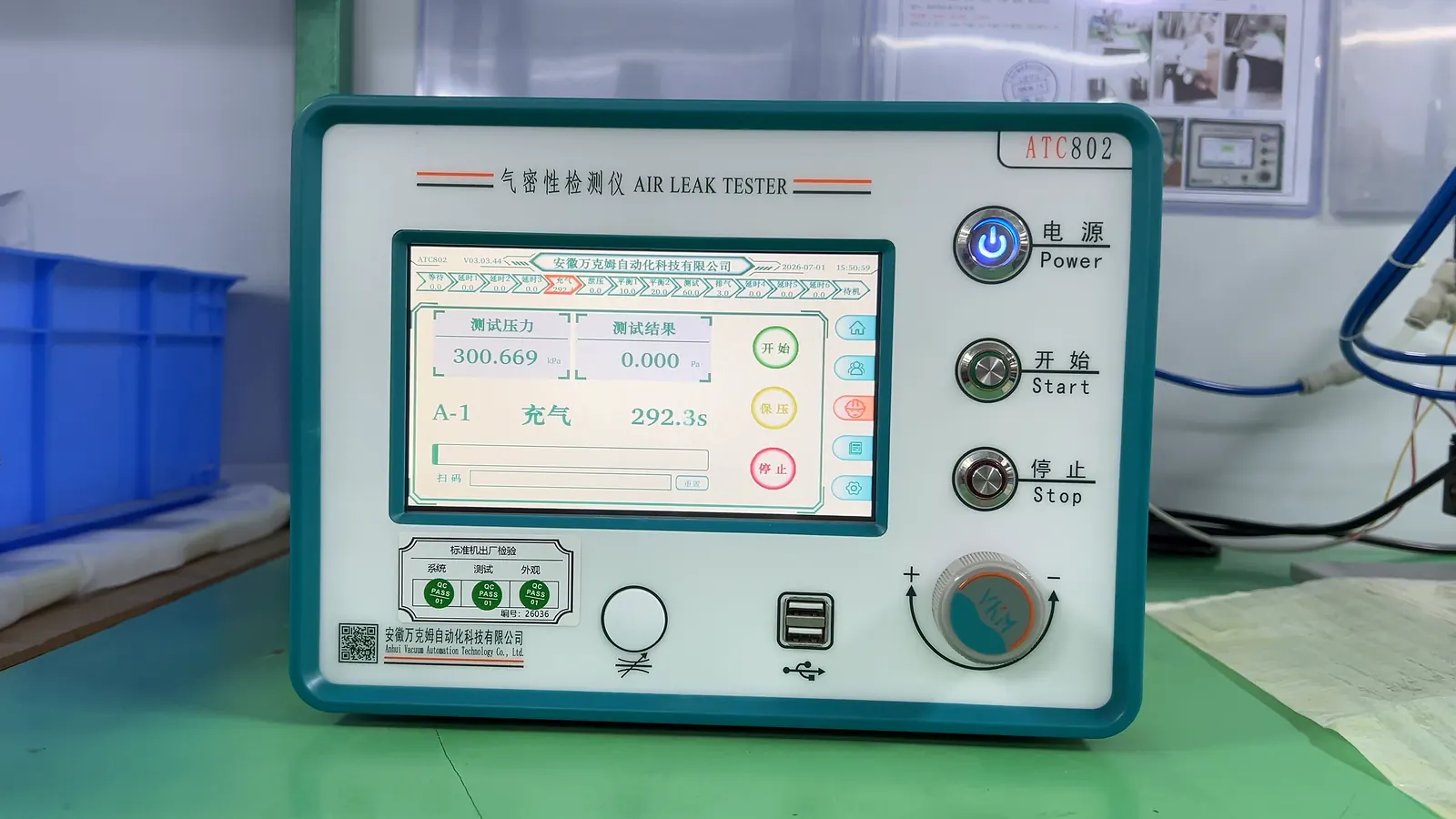
An instrument display of zero is limited by the method’s sensitivity, resolution and test conditions. It is not proof of zero leakage at every scale. INFICON’s DTC leak-detection note explains that pressure-decay measurements are sensitive to temperature changes and do not identify the exact leak location. Its equipment capabilities and example limits are not ThermalBro acceptance criteria.
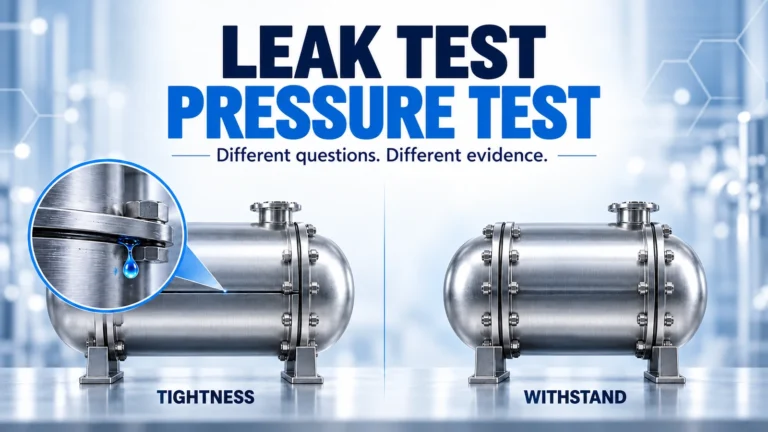
For the distinction between tightness and pressure exposure, see our leak test versus pressure test comparison. This article addresses the additional evidence needed to make a service-life claim.
Explain what can change after the factory test
A test evaluates the condition that exists during the measurement. Later service can change material properties, joint loading and the physical integrity of the assembly. Those mechanisms need to be considered separately from defects that the production test can detect at shipment.
Elastomer behavior depends on the specific compound, fluid and exposure conditions. Compression set describes incomplete recovery after deformation; it is not, by itself, a binary declaration that a seal leaks. Parker’s ParFab design guide, Appendix B discusses the interaction of compression set, temperature and fluid-related dimensional changes. Use the actual seal supplier’s data and application validation rather than transferring a generic material label into a lifetime promise.
Connect service influences to evidence
Swipe the table horizontally to compare all columns.
| Service influence | Question for the reliability review | Evidence to request |
|---|---|---|
| Temperature and pressure changes | Can repeated changes affect joints or sealing contact? | Defined duty and relevant cyclic exposure results |
| Coolant and wetted materials | Does the specified fluid remain compatible with the complete material set? | Composition, temperature and compatibility evidence |
| Transport and mounting | Can loads reach hoses, ports or joined features? | Installed routing, restraints and applicable handling validation |
| Connection maintenance | What changes when an interface is opened and reconnected? | Approved service instructions and recovery checks |
| Production variation | Does the tested construction represent shipped units? | Revision control, traceability and process/inspection records |
The mechanism determines the test. A thermal exposure cannot stand in for every vibration or connection-cycle question. Equally, making every exposure more severe without justification can introduce a failure mechanism that is not representative of service. The validation plan should explain why the chosen stresses address the intended duty.
Build a qualification plan around a defined use profile
“Five years” or “continuous operation” is incomplete without the conditions during that period. The equipment owner must define the expected operating range and relevant transitions; the supplier and validation team then identify what evidence their assembly scope needs.
- Describe the duty. Record coolant composition, temperature and pressure ranges, startup/shutdown behavior, environmental exposure and permitted maintenance events.
- Identify vulnerable interfaces. Map the seal, hose, fitting and joined-part mechanisms relevant to that construction. Assign evidence owners for supplied and site-added interfaces.
- Specify samples and exposures. Select representative revisions, manufacturing conditions, exposure sequence and inspection points. Define failures and acceptance rules before testing.
- Review and close gaps. Compare results with the intended duty, investigate exceptions, and document remaining restrictions or changes before release.
Include baseline and subsequent leak checks where they help detect change, with comparable measurement conditions. An intermittent leak that appears only in a particular operating state can be missed by a room-temperature check after the assembly has stabilized. Decide whether monitoring during exposure is needed for the mechanism under review.
From the initial evidence to the release decision
Identified assembly and test condition
↓ Record whether the stated leak criterion was met.
Representative duty and failure mechanisms
↓ Assess behavior under the agreed exposures.
Installation, maintenance and changes
↓ Preserve the qualified boundary or reopen its review.
Keep accelerated testing and lifetime claims separate
Accelerated testing can be useful when the increased stress has a defensible relationship to the relevant degradation mechanism. More hours at a higher temperature do not automatically equal a specified number of years in the field. A change in mechanism, fluid condition or material response can invalidate that conversion.
Ask for the acceleration model, its supporting evidence, the tested population, failures and the statistical interpretation behind any quantified claim. If those are unavailable, report the actual exposure and observed outcome instead of inventing a life-equivalence factor. A statement that samples passed a defined test is narrower than a predicted survival probability over a stated service period.
Likewise, zero failures among tested samples does not mean the population failure probability is zero. The conclusion depends on sample size, duration or cycles, sampling method and the model used. This is why the acceptance plan should state what decision the evidence supports, rather than attaching an unsupported lifetime label after the test.
Walk a changed-service scenario through the decision
Existing evidence may remain applicable
Configuration and duty match the qualified scope, the production record is traceable, and installation follows the approved boundary. Confirm the evidence linkage before release.
A targeted review is required
Fluid, material, routing, connection frequency or operating limits change. Identify affected mechanisms and obtain the necessary analysis or validation before extending the claim.
The technical owner decides which evidence must be repeated and which remains relevant. Record the resulting cost, sample and schedule implications. Treating every change as already covered hides risk; automatically repeating unrelated tests wastes work without necessarily closing the new gap.
Preserve reliability evidence through production and service
Qualification of a design and screening of a shipped unit have complementary roles. Qualification does not prove that every assembly was built correctly. A production pass does not reproduce the full qualification duty. Link both to the released drawing, materials, assembly instructions and inspection requirements.
Our manufacturing and assembly scope provides context for the supplied assembly. The project record still needs to identify material substitutions, process changes, repairs and retests. A repaired unit should retain its original result and the approved disposition rather than only its final passing reading.
Keep the four evidence layers linked
Swipe the table horizontally to compare all columns.
| Evidence layer | What it supports | What must remain linked |
|---|---|---|
| Design qualification | Behavior under defined representative exposures | Revision, samples, duty, method and acceptance |
| Production screening | Unit or batch conformity to the specified screen | Identity, assembly state, result and exceptions |
| Installation verification | Interfaces and conditions introduced at integration | Final connections, routing and commissioning record |
| Service control | Approved maintenance and response to changes | Instructions, interventions and required rechecks |
Define leak detection and the equipment response with the system owner where applicable. Detection helps manage a developing event; it does not guarantee prevention. Recovery and return-to-service decisions must follow the approved equipment procedure, including checks of interfaces disturbed during repair.
Write an acceptance statement that the evidence supports
Use wording that identifies the result instead of promising unrestricted future performance. For example: “The identified assembly met the agreed leak criterion under the recorded production test conditions.” Keep that statement tied to the report; it does not replace a separate duty-specific qualification conclusion.
For a ThermalBro testing review, supply the intended duty, tested configuration, medium, method, criteria and any observed failures. Define production screening and qualification scope separately. Specialized methods, exposure programs and reporting requirements must be agreed for the project.
Questions when a supplier offers a leak-free claim
Does a warranty establish the engineering lifetime?
A warranty describes agreed commercial coverage and conditions. It is not a substitute for the technical evidence behind a reliability claim. Review both the contractual scope and the tested duty without treating them as interchangeable.
Should every shipped unit receive the full lifetime test?
Not automatically. Qualification and production screening serve different purposes, and some qualification exposures consume life or alter samples. Define production controls based on the design, failure mechanisms and agreed quality plan.
Can a stronger pressure test replace the missing life evidence?
No. Pressure exposure addresses its specified objective and may stress the assembly differently from service. It cannot replace evidence about chemical exposure, cycling, handling or maintenance. Have qualified personnel define any pressure procedure against approved limits.